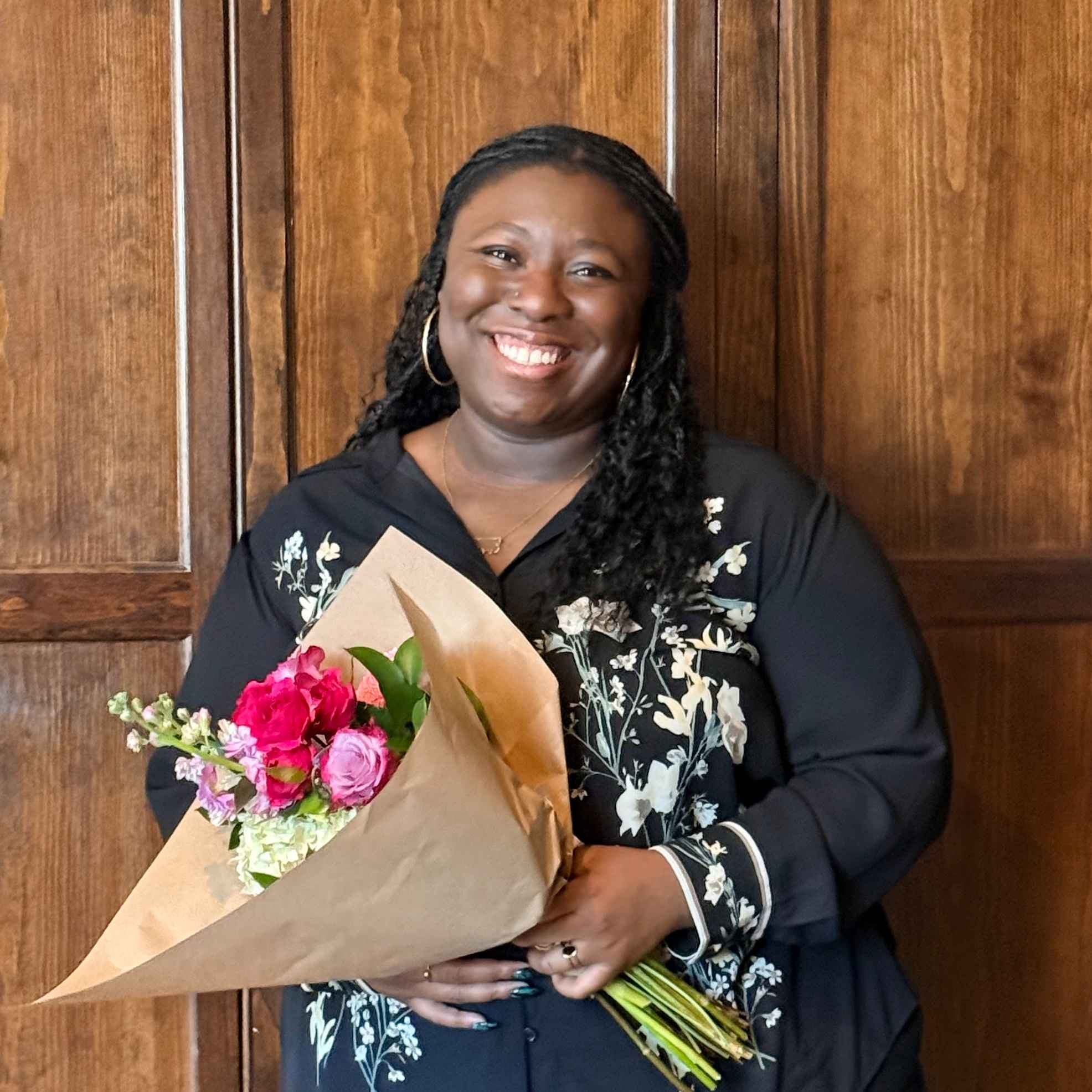
 A Decade in the Making
Before Semilore Sobande came to Brown for her doctoral degree, she nearly walked away from literature altogether. "A decade ago, when starting my literary journey, I felt the questions I wanted to study weren’t particularly interesting, and like the research I wanted to pursue was impossible, " she recalls. Today, she is the 2026 winner of Brown University's Joukowsky Outstanding Dissertation Prize in the humanities, one of the most prestigious honors a doctoral candidate can receive.
The prize recognizes Sobande's dissertation, Ghostwriters: Blackness, Gender, and Nostalgia in 20th Century Transatlantic Fiction, a sweeping literary analysis that challenges long-held assumptions about which influences are truly shaping fiction. "The project has been through a lot of iterations over the past several years, so it's wonderful to know that it has come together in a way that people can find meaning in," she says.
A doctoral candidate in English, Sobande’s award-winning research was shaped by a prestigious academic journey, including a year in France as a Fulbright Fellow at the International Research Center on Slavery and Post-Slavery, a research lab sponsored by the French National Center for Scientific Research. With a background in African and African-American Studies and Comparative Literature, Sobande brings a unique, global perspective to the humanities at Brown University.
Her recent “honors speak to the strength of her work as a scholar who has not only written a solid dissertation, but one who innovates and productively pushes the historical, linguistic, and theoretical frameworks of various fields, including black critical theory, black feminist theory, postcolonial theory, narrative theory, and African Diaspora studies,” shares Dixa Ramírez, Associate Professor of English.
What Holds the Story Together
Sobande's central argument is straightforward: black women are the hidden narrative architects of some of the most celebrated works of the twentieth century. Even when they aren't the main characters, even when they seem peripheral, their presence is what makes these stories possible.
"There is often this sense that the literary world is bifurcated, where white authors only wrote about whiteness for centuries and then authors of color started writing about race in the 20th century," Sobande explains. "Yet as I started exploring more of black studies, black feminist theory, and postcolonial theory, the usefulness of racial discourse to these texts that supposedly had nothing to do with race became clearer."
Her framework draws on black critical theory, black feminist theory, postcolonial theory, narrative theory, and African diaspora studies, weaving them together to show how beliefs about black womanhood function as what she calls the "seam" of a novel: invisible to most readers, yet essential to holding everything together.
From Faulkner to Morrison
The dissertation moves across languages, borders, and genres. In her first chapter, she analyzes the 1935 French film Princess Tam Tam, arguing that its protagonist's failed mimicry of French culture exposes colonial fears around integration. Sobande then examines the ahistorical Haitian slave revolt at the heart of William Faulkner's Absalom, Absalom! and its relationship to the black female members of the Sutpen family. Her third chapter turns to Jean Rhys's Wide Sargasso Sea, reading the character Antoinette as a ghostly, haunting presence affected by racial narratives around white creole women in the Caribbean. The dissertation closes with Toni Morrison's A Mercy, tracing how the novel illuminates how Black people shaped the very construction of narratives about white modernity.
"Semilore has the gift to discern rich literary and conceptual linkages between texts that are not often considered together," says Olakunle George, Professor of English and Africana Studies. "With this dissertation, she has done so with aplomb."
Between the Document and the Story
Sobande's process was as expansive as her argument. She began with nine texts and ultimately narrowed to five, dividing her analysis to give each work the attention it deserved. But the most transformative part of the research, she says, happened away from the desk.
"I think the most valuable piece was spending time in archives, where interacting with documents and manuscripts made clear the distance between document, discourse, and literary event," she reflects. The guiding question throughout: "How do these questions of race, invisibility, and narrative determine the stories we choose to tell?"
The result, her advisors say, is a dissertation that doesn't just contribute to existing fields — it reshapes them. “Ghostwriters promises to break new ground in various fields, including black feminist studies and theory, black critical theory, African diaspora studies, and beyond. Her approach and choice of texts, as well as the bilingualism of the project, builds on these fields while stretching at least one of their boundaries,” says Ramírez.
A Scholar and a Teacher
Sobande's impact at Brown extends beyond her dissertation work. In addition to working with the Writing Center and the Fellowships Office, Sobande has taught several courses at Brown as the instructor of record focused on black women’s literature with syllabi that include authors such as Morrison, Yvonne Vera, Jamaica Kincaid, Saidiya Hartman, and Hortense Spillers.
"Semilore has been passionate about creating a classroom that does not shy away from difficult conversations with compassion for the variety of potential student responses," says Ramírez.
An article version of her second chapter is forthcoming in Modernism/modernity, a leading journal in the field.
What Comes Next
"As she completes her doctorate in English at Brown University, Sobande is already emerging as a distinctly exciting and promising scholar within the fields of global Black studies, Black Feminism, and of Anglophone and Francophone literary and media cultures," says Aliyyah I. Abdur-Rahman, Professor of American Studies and English.
For Sobande, the prize is something more personal than professional validation. "Being selected for this award is an honor," she says. "In many ways, it feels very surreal."
Doctoral candidates and graduates, Gray Barber Babbs, Sarah Ferris Christensen, Meg Shieh, and Semilore Sobandewere selected for the Graduate School's Joukowsky Family Foundation Outstanding Dissertation Award. Prizes are awarded at the Doctoral Ceremony on May 24, 2026.